

Choosing an Athens location for a EUR 250,000 commercial-to-residential conversion project is not the same as choosing a standard apartment from a map. The special Greece Golden Visa route is property-specific: the legal conversion, transaction structure and technical documentation must be correct first. Location due diligence then asks a second question: will the completed residential home work well for the buyer’s intended use?
This guide is designed for buyers comparing conversion opportunities in Athens. It does not name a universally “best” district or promise a financial outcome. Instead, it provides a practical way to compare a real street, building and final residential configuration before a reservation or purchase decision.
Start with eligibility, not a neighbourhood label
Under the special EUR 250,000 route, qualifying main spaces must have been converted from commercial use to residential use under the applicable framework. This is different from the standard residential-investment routes. A good address, a polished renovation or a statement that a unit is outside a high-demand zone does not establish conversion-route eligibility.
Before comparing neighbourhoods, request the property-specific legal and engineering file. The lawyer and engineer should confirm the former use, the relevant change-of-use documentation, the exact unit being transferred and the timing requirements that apply when the residence application is filed. Read the companion EUR 250,000 conversion eligibility guide and the engineer-report checklist before treating location as the deciding factor.
Use a four-layer location review
1. The immediate street
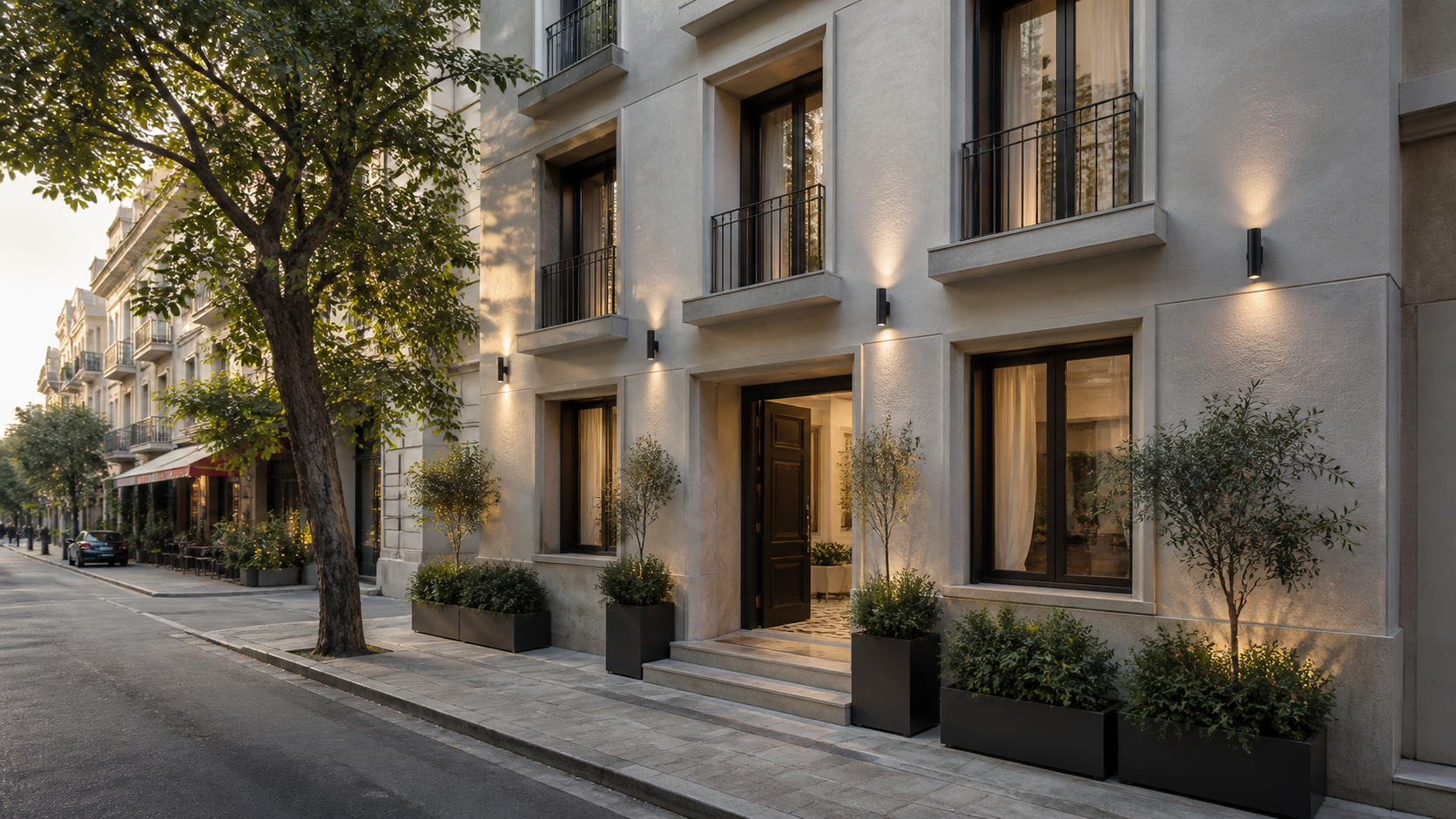
Visit or inspect the precise frontage rather than relying on a district name. Consider the entrance, pavement condition, street lighting, daytime and evening activity, vehicle noise, loading activity and the relationship to adjoining buildings. For a former commercial building, the residential entrance and arrival experience deserve special attention. A legally convertible building can still produce an awkward residential experience if the access, privacy or street interface has not been resolved well.
2. Everyday movement
Check the walking route to public transport, food shops, pharmacies, cafés, parks and other daily services that suit the buyer’s own plans. “Close to” is not a substitute for a walkable route. Note gradients, crossings, shaded or exposed paths and the time of day when the route was observed. If the home may be used by a family or an older relative, accessibility, lift access and the route from pavement to door matter as much as the district’s reputation.
3. The building’s conversion logic
Commercial buildings were not originally designed for the same patterns of daylight, ventilation, acoustic separation and private outdoor space expected in a home. Ask to see the final residential plans for the exact unit. Confirm window positions, orientation, ceiling height, storage, circulation, bedroom layout, bathrooms, shared areas and the treatment of any internal spaces. The right question is not simply whether a conversion is allowed. It is whether the finished home will be coherent and usable after delivery.
4. The ownership plan
Different buyers value different things. A buyer who expects to spend time in Greece may prioritise a familiar daily rhythm, connections to family or schools, and straightforward travel across the city. A buyer focused on residence status may prefer a clearly documented project and predictable delivery sequence. A future resale is never guaranteed, so a prudent buyer should focus on the quality, documentation and ordinary usability of the completed home rather than on unverified price-growth or rental claims.
How to compare Athens areas without oversimplifying them
Athens contains many distinct neighbourhood patterns, and a conversion opportunity should be evaluated in context. Central locations can offer an established urban rhythm and a dense service network, but buyers should inspect street-level noise, building condition and the proposed residential layout carefully. Areas along the Piraeus and southern transport corridors may offer different access patterns and building types; that does not make them interchangeable. Kallithea, Moschato, Tavros and other locations can each require a different balance of daily convenience, street character, building configuration and connection to the buyer’s own routine.
Do not assume that a coastal, central or transport-connected label proves suitability. Compare the actual project with the buyer’s intended days in Greece. Ask where groceries will be bought, how visitors arrive, whether the entrance feels residential, how the unit receives light, and what construction or communal work remains before handover. These observations turn a broad area search into a property decision.
Questions to put to the project team
- Which documents show the former commercial use and the lawful change to residential use for this exact unit?
- Can we see the final approved plan, the sales specification and the common-area plan together?
- What construction, utilities, lift, entrance or common-area work remains before delivery?
- How does the building entrance operate during the day and evening?
- What are the realistic walking and transport routes from the building?
- Which costs are recurring owner costs, and which are one-off completion or transfer costs?
- Can an independent lawyer and engineer review the file before any binding commitment?
Build a comparison sheet before choosing
When comparing several projects, place the facts in one written sheet rather than relying on memory after viewings. Include the exact address, unit number, prior use, change-of-use document, building stage, final area and layout, access notes, daylight observations, surrounding activity, handover conditions, title-review status and payment sequence. This makes it easier for the lawyer, engineer and family decision-makers to identify what is confirmed, what remains open and what needs to be included in the contract.
For payment structure and total-budget questions, use the separate payment trail and purchase-cost guide. For broader residence questions, the Greece Golden Visa Encyclopedia groups the relevant official guidance and buyer questions in one place.
Where Santheos can help
Santheos presents commercial-to-residential conversion opportunities in Athens. Availability, construction status and eligibility are assessed project by project. Browse the current Golden Visa project directory, then ask for the documentation and location context for a specific available unit. A buyer should always obtain independent legal, tax and technical advice tailored to the intended transaction and application.
Editorial note and official source
Prepared by: Santheos Research & Project Team.
Last reviewed: August 2026.
Important: This article is general information, not legal, tax or immigration advice. Eligibility is subject to final legal review and the rules in force at filing.
- Greek Government Mitos registry: permanent Golden Visa (change of use) – initial issuance
- Greek Ministry Circular 9/2024
Discuss a conversion project and its location context with Santheos.
Continue your research
- EUR 250,000 Greece Golden Visa: Commercial-to-Residential Conversion Eligibility
- Engineer Report for a Greece Golden Visa Conversion Project: What It Must Confirm
- EUR 250,000 Conversion Golden Visa Greece: Payment Trail and All-In Budget
Prepared by: Santheos Research & Project Team. Last reviewed: August 2026. General information only, not legal, tax or immigration advice. Eligibility is subject to final legal review. Review the Greece Golden Visa Encyclopedia, the official Mitos entry, or contact Santheos for a property-specific discussion.


